UK Crop Conditions
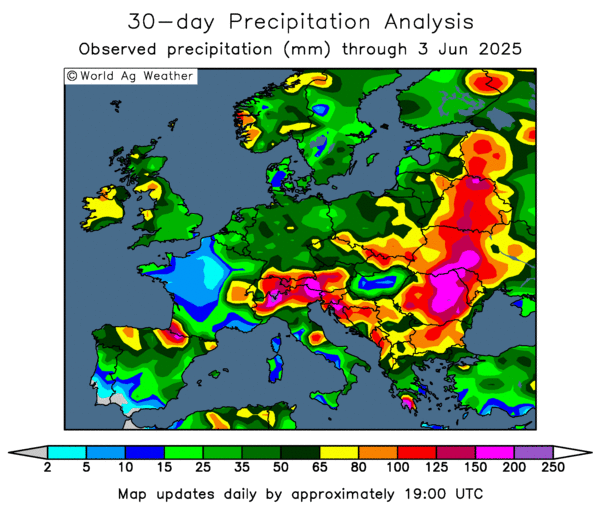
Looking at the statistics for my part of North Yorkshire today I can say that we had only 16.8 mm of rain during May. Normal is 40-60 mm, according to the Met Office. It is worth noting that if we hadn't have had this shift to wetter weather coming on from the west at the end of last week, we'd have finished May with less than 10 mm of rain.
Temperature-wise we peaked at a balmy 27.7C on May 22nd, Mrs N#3's birthday as it happens, righteous person that she is. Exactly a week later on the 29th when we got 6.9 mm (over 40%) of our months rain, the daytime high was just 11.4C. That's the British weather for you.
Despite the blip into the upper 20's, overall May was cooler than normal, averaging just 10.6C.
On a national level, crop development remains 7-10 days behind recent years, according to ADAS.
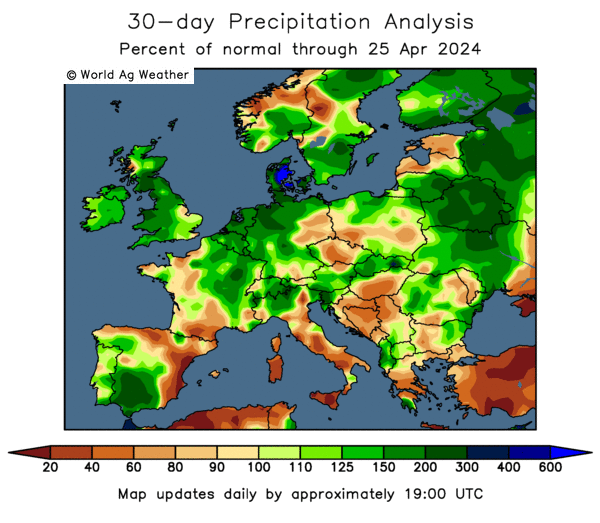
"The dry weather in April and May, with rainfall around 60% of the long term average for these months, has raised concerns over moisture stress, particularly in crops on light land. Soil moisture deficits at the end of May are approaching 100mm in eastern regions, and crops are showing signs of moisture stress," they say.
"Less than 10% of (wheat) crops have reached boot swollen stage at the end of May compared to around 50% in the last two years," they add.
High levels of black-grass in wheat are also an issue this season, they conclude.
Read the full report here.
UK Crop Conditions
UK crops are around 10-14 days behind schedule according to the HGCA/ADAS. Widespread cold and wet conditions during March mean that crops have been slow to start spring growth they say. Winter wheats have "generally survived the winter well", whilst winter oilseed rape crops have "improved considerably" after looking "poor and stressed" a month ago, they add.
Full story here
UK Crop Development
Those nice boys at Farming Online have put together an interesting summary of the latest crop conditions up and down the country here.
Winter rapeseed seems to be generally looking "a bit sad", displaying few signs of new growth and suffering from fairly extensive pigeon damage, they say.
The recent drier slightly warmer weather seems to have generally improved ground conditions significantly however.
Winter wheat in the eastern counties is described as "actively growing" although not much growth is being reported in the west and the north.
Winter barley is looking "fully tillered, but some very yellow and need some warmer drier weather...before they will pick-up," they add.
UK Crops Well Behind Last Year
ADAS is reporting that UK winter grains and oilseeds are generally well behind last season in terms of development.
A combination of late drilling, cloddy soils and colder temperatures, particularly in the north and the west, means that the chances of hitting last season's production levels have been dealt an early blow.
Around 10% of planned winter wheat acreage hasn't even made it into the ground, they say. This coincides with a recenr Farming Online survey.
Only about 20% of wheat crop has started tillering, well behind 50% at the same time last year.
Some planned winter barley acreage also won't make it, and is now likely to be sown in the spring, they say. Around 40% of what has been sown is tillering, just half of the 80% that was tillering twelve months ago.
Winter oats are estimated at 20% tillering, compared to 60% a year ago.
Winter oilseed rape development is very varied, they say, with some crops very small in areas where drilling was delayed or soil conditions poor.
Winter beans have also got off to a poor start, with fewer acres planted than had been anticipated, again largely due to wet conditions.
Throw reduced fertiliser inputs into the equation, due to cost & financial considerations, and we could be looking at significantly lower output in 2009, particularly if Mother Nature doesn't co-operate.