Harry Potter My Arse
Went to see the new Harry Potter & the Half Blood Prince tonight. What a load of rubbish, talk about far-fetched. A ginger kid with two friends?
The Ginger One even had a girl chasing after him, how unlikely is that.
Harry appeared to lose his cherry though. There'll be Hogwarts all over his magic wand by the end of the week, you mark my words.
I won't spoil it for you though, let's just say that Sir Ian McKellen's contract has obviously come to an end.
CBOT Closing Comments
Soybeans
August soybeans closed down 3 1/2 cents at $10.20 a bushel, November soybeans closed down 17 3/4 cents, further widening the old crop/new crop spread. If there's one bullish story in town for beans it's got to be old crop tightness. Exports are running at a strong pace and accumulated exports for the 2008/09 marketing year so far are 1.168 billion bushels. USDA export estimates for the full 2008/09 marketing year are 1.260 billion bushels, and the 2008/09 marketing year doesn't end until the first week of September. Beyond that though you've got to be bearish, with record production expected in the US come the autumn, plus probable record production in South America in the spring.
Corn
Sep corn ended down 10 3/4 cents at $3.16 1/4 per bushel and Dec corn ended down 11 1/2 cents at $3.27 1/4. US weather conditions are pretty good right now, plenty of moisture and no heat stress. Some concerns are around over the low number of growing degree days with continued forecasts for unseasonably cooler than normal temperatures. This leaves a late planted, slow maturing crop vulnerable to an early freeze should one come along in the autumn.
Wheat
September CBOT Wheat at $5.16 ¼, down 15 ½ cents. Weakness from corn spilled over into wheat today, and the market still has a cautious eye on what the FCTC regulators may do to attempt to improve CBOT wheat convergence with the cash market. Limiting index fund activity in wheat is still a possibility, which may lead to wide scale liquidation of wheat longs. With the CBOT soft red winter wheat contract the benchmark for global wheat prices, despite accounting for only 2% of the world wheat crop, that is a major concern.
EU Wheat Continues To Slide
EU wheat futures continued their slide Friday with Paris November milling wheat closing down EUR1.25, or 0.9%, at EUR138.00/tonne, and London November feed wheat trading down GBP1.25 at GBP106.00/tonne.
There is very little fresh news, it's all very much a case of same old, same old. Harvest is upon us, although rain is a problem in parts of western and northern Europe.
Further east if anything it remains too dry, harvesting is well advanced in Russia and Ukraine, and quality is better than last year although yields are down.
Elsewhere in the world US prices are falling and rains have finally arrived in Argentina, although plantings there are wrapping up. After that it will be all eyes on Australia, where wheat has largely got off to a great start, although El Nino weather potential could change all that.
El Nino is also being blamed for poor monsoon rains in northern India. Poor rains now will affect soil moisture when wheat goes into the ground later in the year, and also reduce irrigation potential.
There is an old saying that the cure for high prices is high prices. That certainly seemed to prove to be the case last season, after every man & his dog planted wheat, encouraged by sky-high levels. Maybe also the cure for low prices is low prices?
eCBOT Close, Early Call
The overnight markets closed narrowly mixed, with nearby August beans 4 cents higher and the bulk of the other more active contracts around 3-4 cents lower. Wheat and corn closed mostly with just token gains of less than a cent.
Cool and wet conditions prevail across large parts of the Midwest, which may not be harming but isn't helping corn, beans or spring wheat development on late-planted crops. As we know a late harvest means potential vulnerability to an early freeze.
The USDA report 116,000 of new crop beans sold to guess who overnight. That's right the cheeky Chinese are still in the market.
It looks like they are going to auction off more corn and beans next week. Or at least attempt to. With prices likely to be set where they were this week they are unlikely to find any soybean buyers. Only around a third of this week's corn offers got taken up, so that might not go too well either.
The USDA are widely expected to reduce corn acres in their Aug 12 WASDE report, after they announced a 'recount' this week. What's the betting that they will reduce acres and increase yields by an equivalent amount to leave us with almost exactly the same number we started with?
If they do reduce corn acres then, although they won't issue a revised soybean acreage number, it surely implies that there are more new crop beans in the pipeline. As they are probably understating soybean yields too at the the moment, there are probably a lot more beans in the pipeline.
Old crop beans are still very tight though, and look set to continue that way with Chinese buyers still coming back to feed at the trough.
Some of the panic has gone out of the wheat market, as it now seems more likely according to trade talk that the CFTC will only make a few storage tweaks to the CBOT contract, rather than demand a wholesale review of index fund activities. The latter could have started an exodus from wheat futures.
Crude is holding it's own around $67/barrel and the dollar and equity markets are looking pretty flat to end the week too.
Early calls for this afternoon's CBOT session: corn called steady to 2 higher; beans called 2 to 4 lower (Nov); wheat called flat to 2 higher.
Chicago Wheat Contract - Too Big For It's Own Boots
The Chicago wheat contract is seen as the global benchmark for wheat prices around the world, and there has been much talk recently of how is has become detached from the physical market.
In 2005 the average differential between the CBOT contract at expiration and the Toldeo cash price was just 5 cents, by 2008 averaged over $1 (peaking at over $2 at it's worst). Even despite the capitulation of the market since then when the July CBOT contract expired recently this gap had only narrowed to 83 cents. Since the roll to September, however, basis has weakened again and cash is currently $1 or more under futures at most locations.
If CBOT prices don't accurately reflect real cash prices, then hedgers will shy away from the contract, hedging elsewhere or in some cases not at all.
So what's wrong with the Chicago wheat contract? In short it's got too big for it's own boots.
The CBOT contract is for soft red winter wheat, whereas the Kansas futures contract trades hard red winter wheat and the Minneapolis contract is for hard red spring wheat.
The soft red winter wheat crop traded on Chicago constitutes only around 20% of the total US national wheat production, and just 2% of global wheat production. That's right, the most actively traded wheat contract in the US (and the benchmark for the rest of the world) doesn't even trade the most widely grown wheat type there.
Despite accounting for a significantly smaller share of the production marketplace than it's KCBT or MGE counterpart, trade and open interest in CBOT wheat is many times larger. It's the volume that they trade in CBOT that makes it attractive for the index funds, and it's the size of open interest that the index funds hold (typically 50%) that is making the contract so unattractive to commercial hedgers.
In mid-2008 index funds held enough CBOT wheat contracts to cover US production of soft red winter wheat for the next three years! They are currently still long around twice the estimated 2009 production.
Clearly the CME Group, owner of the Chicago Board of Trade, does not want to see this kind of volume go away, and maintain that index funds were not responsible for volatility in the wheat market last year.
Why are the index funds still holding so much wheat? The large carry, Dec 09 wheat closed at $5.59/bushel last night, whilst Dec 10 was $6.32 1/2. That differential offers a better return than can be had on the money markets at the moment.
There doesn't seem to be an easy quick fix solution. One proposal being looked at by the Commodity Futures Trading Commission (CFTC) regulators is increasing storage charges. I don't see how that is going to help, that would widen the carry not decrease it, as we know the index funds don't intend to actually take delivery.
A better method to ensure convergence surely would be via a cash-settlement basis. If you let your contract expire you don't have the obligation or option to opt for physical delivery. A little bit like having a bet with the Tote, if you let your bet (contract) expire then you don't know at what price it will be settled at until after the event when a settlement price is announced based on cash market prices.
Rain, Rain Go Away
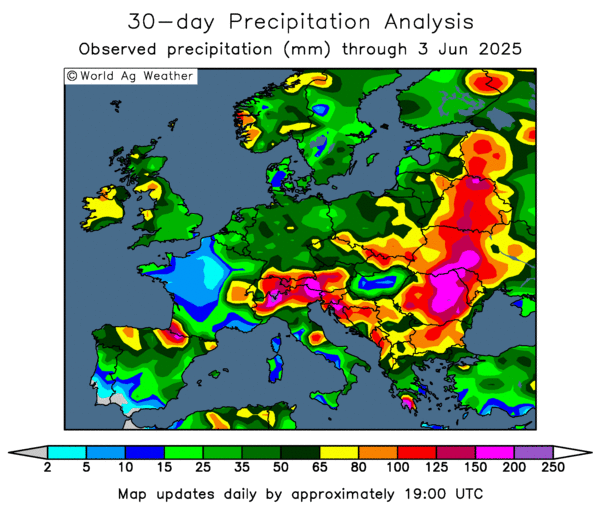
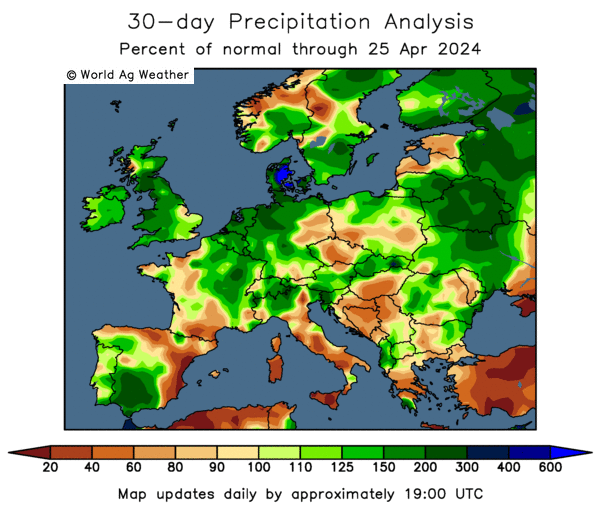
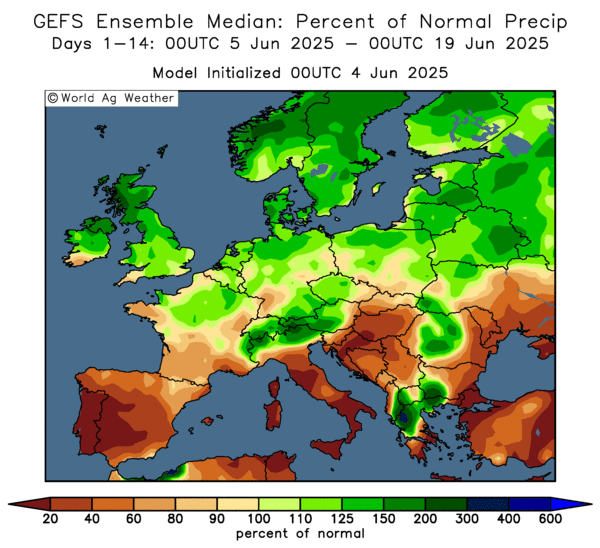
It tanked it down here in North Yorkshire yesterday, much more so than what was in the forecast, or even in fact than what showed up on the radar images after the event.
It certainly wasn't the predicted sunshine and showers day that the forecasters were saying, when the 'showers' did arrive, which seemed to be about every half hour, they were very heavy downpours indeed.
It would appear that there are similar problems all over the country and elsewhere. The Irish farmer who was recently quoted as saying something along the lines of "this year's harvest will be fine, I've never known three washouts in a row" may be starting to regret his misplaced blarney.
"This is the third year in a row of really dreadful grain growing conditions with no light on the horizon for better harvesting conditions as it continues to pelt it down. Winter barley crops are beginning to suffer from the onslaught of recent weeks and, everywhere now, one can see areas of fields lying over. My own crop is no different. It is with dismay that I look across the fields and view the ever-growing flat patches," is how one farmer quoted in the Irish Independent sees it.
"Floodwater carves 25m gully through barley field," is one headline from our own County Durham this morning. The trench is apparently 'hundreds of metres long and up to four metres deep.'
Rain appears to have stopped play elsewhere in Europe too with Reuters saying "Constant showers have disrupted Germany's barley harvest in the past two weeks. The pattern of showers followed by cloudy, humid weather may bring fungal growth on wheat if it continues in the next two weeks."
The compounder who emailed me a few months back saying that his main concern this year was the number of farmers carrying 'rubbishy' old crop into new, may be looking to pay a premium for that 'rubbishy' old crop before long!
Spanish Grain Production Estimates Revised Lower
The Spanish agriculture ministry has revised down this year’s wheat and barley production estimates.
Wheat output (excluding durum) is now projected 32% lower this year at 3.8 MMT, from the Ministry's previous forecast of 4.3 MMT and 5.6 MMT in 2008/09. Durum wheat output is seen at 1.2 MMT, similar to last season's 1.1 MMT.
This season's barley crop is now forecast at 7.5 MMT, compared to the previous forecast of 8.6 MMT, which is 33% down from the 11.3 MMT harvested last year. The total includes 6.4 MMT (9.6 MMT in 2008/09) of spring barley.
The corn crop should equal last season's 3.6 MMT, they say.
I'll Name That Chart In One

It's certainly not London wheat that's for sure. This little baby is sugar, which hit it's highest in three years yesterday. This is New York sugar which peaked at 18.39 cents a pound yesterday, the highest since March 2006.
In London, white sugar closed at $474.90/tonne last night, the highest finish since July 2006, this morning it's currently at $475.90/tonne.
The reason for the rally? The lack of monsoon rains in northern India, the world's biggest consumer, leading the government there to meet yesterday to discuss an extension of the existing tax-free concessions on sugar imports.
World demand is outstripping supply by over six million tonnes at the moment, and India is set to potentially become the world's largest importer this year, having been a net exporter only a couple of years ago.
The reason for the switch? You guessed it, Indian farmers decided to get out of sugarcane production and get into the much more profitable grain sector!