Are We Only One Disaster Away From Disaster?
 06/01/11 -- Winter wheat conditions in the US are giving plenty of cause for concern, with the world looking to America to make up for Russia's unintentional shortcomings last year with a strong performance in 2011. Could we be just one more disaster away from a really BIG disaster?
Certainly US farmers have done their bit, encouraged by rising wheat prices to up their winter plantings by 12-14%, according to Allendale/Farm Futures Magazine.
It's the condition of these 42 million acres that is now giving cause for concern. The USDA have stopped giving weekly condition ratings, as is customary at this time of year.
In their last report at the end of November they pegged national all wheat crop conditions at only 47% good/excellent, a whopping 16 points below where things were twelve months previously.
Hard red winter wheat, of the type grown in the top wheat producing state of Kansas and which comprises nearly 60% of all US winter wheat, was rated 42% just good/excellent nationally, 39% fair and 19% poor/very poor back then.
A survey out by the Kansas Agricultural Statistics Service this week now pegs good/excellent conditions in the state at only 27% as at the end of December, with poor/very poor ratings having climbed to 33%.
This deterioration has largely been due to persistent dryness, with the state only getting 68% of normal rainfall October/December, according to Martell Crop Projections. Mercifully, relatively mild December temperatures have largely spared the crop - much of it unprotected by a blanket of snow - from significant winterkill damage. Up until now that is.
By the early part of next week however very cold polar air is forecast to push into central areas of the US, including Kansas, and by Tuesday January 11 the minimum temperature outlook is very cold indeed with temperatures some 10-20°F below normal.
Unless unprotected Kansas gets a beneficial snowfall before then, things could easily go from bad to a whole lot worse for the state's wheat growers. And that could knock another chunk off the global production bottom line, one that is already 20 MMT behind projected consumption in 2010/11.
Signs That US Wheat Yields May Disappoint
The Kansas Wheat Quality Council concluded day one of their annual wheat tour yesterday pegging yields in the state at 40.7 bu/acre. That's surprisingly lower than last year, when their first day estimate was 41.3 bu/acre.
The results are particularly surprising given that the USDA rated Kansas wheat 70% good/excellent on Monday night, up from 53% a year ago when final yields came in at 42 bu/acre.
Early indications are that late-planted wheat in the state looks set to disappoint. Kansas is of course the top US wheat producing state, and accounts for around a quarter of all winter wheat production in the US.
Tour members are back out scouting the crop today and tomorrow and will issue a final yield estimate on Thursday night.
US Winter Wheat Crop Conditions
Field conditions might be cold and soggy in the Upper Midwest ahead of spring wheat plantings, but the outlook in winter wheat states further south is improving.
The USDA last night said that 63% of winter wheat in Kansas is rated good to excellent, up three points from a week ago. Conditions in Oklahoma saw a similar improvement, also up three points to 68% good/excellent.
Further south still Texas wheat jumped from 45% rated in the top two categories to 55%.
Topsoil temperatures are much warmer in these southerly states on the Great Plains than further north, where a thin layer of snow is still present in South Dakota and Minnesota, keeping fields cold and holding soil temperatures down in the 30's F.
Image courtesy of Martell Crop Projections:

US Winter Wheat Latest
There are three classes of winter wheat grown in the US:
Hard Red Winter wheat, grown mainly in southern and central states like Kansas, Oklahoma and Texas.
Soft Red Winter wheat, grown mainly in the heart of the Midwest in states like Illinois.
Soft White wheat, grown mainly in the Pacific Northwest in states like Washington.
Winter wheat is starting to emerge from dormancy in mixed conditions after the EL Nino effect typically diverts Pacific storms northwards up the coast of British Columbia, avoiding Washington, the 3rd biggest US winter wheat state. The subtropical jet stream however frequently delivers storms to southerly states like Texas and Oklahoma, says Gail Martell of Martell Crop Projections.
This year Texas has received plenty of rain with the state wheat rating improving on March 1 to 46% good-excellent, 36% fair and 18% poor-very poor. That represents a strong increase from a month earlier when just 31% of wheat was good-excellent and 29% was poor-very poor. West Texas has a semi-arid climate, and above-normal winter precipitation almost always leads to a favorable wheat yield, says Gail.
Further north things aren't looking as good. The top US wheat producing state is Kansas, which alone grows nearly one-quarter of the US crop. Here, a dry winter played a significant role, and so did cold temperatures that remained below freezing in February when wheat here hardly grew at all, adds Gail.
The Kansas wheat rating dropped to 53% good-excellent March 1, down from 75% in November, based on USDA reports. Oklahoma wheat also deteriorated, falling to 60% good-excellent from 80% last fall, notes Gail.
However, both these states are expecting heavy soaking rains on the weekend that would replenish dry fields and improve growth potential in hard red winter wheat, Gail forecasts. Waves of showers are predicted Sunday-Tuesday in western Kansas with a developing storm in the Central Rockies. This could be a big rain maker for the top US wheat state as the storm tracks slowly eastward, she adds.
In the Midwest soft wheat prospects are dismal, where the production outlook is constrained by a 29% cut in the planted area, says Gail. Wheat was planted late and was under-developed when winter dormancy set in. Illinois wheat has deteriorated in a stormy and cold winter, dropping to 28% good-excellent, 49% fair and 23% poor-very poor on March 1.
In the white wheat areas of the Pacific northwest, below-normal rainfall with El Nino is damaging for wheat potential, Gail observes. Available soil moisture for spring growth is reduced, because of sub-par winter precipitation, 25-35% below normal in Washington. Producers indicate yields will be down, unless spring showers are unusually heavy. Most of the annual precipitation occurs from November through March, so a winter drought is especially damaging for wheat, she says.
Overall it seems like a pretty mixed bag of outlooks for winter wheat. Whist Texas looks like it could be in for a bumper crop, the state only produces around 6% of the national crop.
The combination of cold temperatures and wet fields may well be delaying fieldwork in many other states.
US Wheat Exports/Stocks
The US only consume around half the wheat it produces, the rest is destined for the export market. If it can find a home, that is, and that is becoming increasingly difficult.
Friday's weekly export sales report for wheat from the USDA threw up a marketing year high figure of 825,800 MT, bringing outstanding sales not shipped yet to 4 MMT, coincidentally exactly the same as a year ago.
What isn't the same as a year ago however is the volume exported so far. At 13 MMT this season's export pace currently lags last season by 5.4 MMT, that's 29%, although the target for the entire year is only 17.5% down on last season.
MMT   Exported YTD  Year Ago  O/s Sales Year Ago  Target  Year Ago
-------------------------------------------------------------------
Wheat     13.0        18.4      4.0       4.0      22.5     27.3
Change    -29%                  unch              -17.5%
Thirty three weeks into the marketing year the US has exported just 58% of the USDA's target 22.5 MMT for 2009/10. A year ago the US had already shipped 67% of it's eventual exports of 27.3 MMT.
It seems that the US is going to have to improve some to meet this year's export target. Despite better sales, last week's actual shipments were 316,604 MT, less than the average of around 400,000 MT so far this season. Indeed, to hit the USDA's 22.5 MMT target, the US now has to average half a million tonnes of exports every week for the remaining 19 weeks of the season.
Even if they can manage to do that, this will mean that the US will only have exported 34% of it's wheat crop in 2009/10, just two years ago that figure stood at 61%.
As the US has been finding it progressively harder to sell wheat, stocks have been building. US ending stocks in 2007/08 were 8.3 MMT, or around 15% of total production that season. By the end of 2009/10 those stocks will have climbed to 26.6 MMT, which is equivalent to 44% of production, IF shipments for the remainder of the season match the USDA's target. If they continue to average 400,000 MT/week then ending stocks will reach 28.5 MMT, or 47% of production. That figure is almost exactly equal to the quantity of wheat the US consumed in the whole of 2007/08!
It's not surprising that winter wheat acres are down for next season's harvest when you look at it like that. If consumption was to fall to the levels of two years ago, the US would almost have enough wheat reserves to feed itself for an entire year without producing a single tonne in 2010/11!
MMT                  2007/08  2008/09  2009/10*  2009/10**
-----------------------------------------------------------
Production             55.8     68.0     60.3      60.3
Exports                34.3     27.3     22.5      20.6
Exports % of Prod'n     61%      40%      37%       34%
-----------------------------------------------------------
Domestic Usage         28.6     34.3     32.2      32.2
Usage % of Prod'n       51%      50%      53%       53%
-----------------------------------------------------------
End Stocks              8.3     17.9     26.6      28.5
End Stocks % of Prod'n  15%      26%      44%       47%
-----------------------------------------------------------
* basis USDA export target
** basis current export pace
US Cash Wheat Price To Discourage Winter Plantings
In the US winter wheat accounts for around 70% of the entire nation's wheat crop. Planting is underway, with the USDA Monday night pegging plantings at 24% complete, compared with 25% normally.
Recent heavy rains in Texas have advanced sowings there to 32% done, and in west, in Washington the crop is 60% seeded.
But what about the top-producing HRW wheat states of Kansas and Oklahoma?
Kansas, which typically accounts for around 25% of the entire crop, is only 9% planted compared to 17% normally. In Oklahoma, which produces around 10% of the nation's winter wheat, only 17% is planted so far compared to 25% normally.
Whist planting conditions are more or less ideal, wheat prices are not.
In Kansas where HRW wheat is grown, cash prices yesterday were reportedly around $4.15/bushel, around 50 cents below the KCBT futures price.
Further east, where they grow SRW wheat, things are even worse. Cash wheat in Chicago was only fetching around $3.60/bushel yesterday, almost a dollar below the Chicago futures price and the widest spread for more than two years.
There are also other things to take into consideration.
Whilst the summer weather has generally been very favourable for those who followed up winter wheat with corn or soybeans, the slow maturity of these crops is squeezing the window of opportunity to get them harvested and get the winter wheat in.
Informa said last week that total winter wheat acreage this year will total 41.63 million acres. This would be a decrease of 1.25 million acres from last year. They see hard red winter wheat losing 900,000 acres.
The USDA report on their ideas for plantings Sept. 30th.
Illinois Wheat Yields Disappoint
Too much rain at the wrong times seems to be the story for Illinois wheat this year, with farms in many of the state's counties reporting lower than anticipated yields and quality.
“It’s been a tough spring,” said one elevator manager. “I don’t remember a year in recent memory that’s been this bad.”
Test weights were especially low on grain brought into Mt. Vernon. Millers prefer wheat at close to 60 pounds per bushel, but much of it here was nowhere near that figure, according to him.
“There was quite a lot of it at 51-52 pounds,” he said. “Most of it was around 53 to 54 pounds. There were a couple loads at 58, but there weren’t too many that didn’t get docked.”
Elsewhere yields were a bit better than expected, but quality was still a problem, with more than half the wheat unlikely to meet miller's exacting standards.
“We got too much rain at the wrong times. Scab was a problem. Coming in at flowering time, we had a lot of rain.”
“A small number of producers who used fungicides had decent test weights,” he said. “A couple who came in here had 70 to 80 bushels. But 50 to 60 was more common. Fungicides definitely helped, but it didn’t make it perfect.”
Oklahoma Wheat Crop 'Worst In Decades'
Oklahoma’s wheat crop for 2009, coming after a barrage of droughts, freezes and heavy rains, is turning out to be what one farmer called the worst in the state since 1955.
Farmers in northern Oklahoma wrapped up harvests this week and some farmers in the Panhandle are still cutting grain, but few are happy with the yields.
A heavy freeze in early April finished off most of the crop in southwestern Oklahoma and badly damaged acreage in the state’s midsection. In addition to that, many parts of Oklahoma received heavy rains in April and May.
“We’re probably going to get less than half the wheat this year as last,” said Mike Schulte, the executive director of the Oklahoma Wheat Commission. “It was a tough year to be growing.”
Time Running Out For US Spring Wheat Plantings
Time is running out for US farmers to get their spring wheat plantings done. With just 50% of the crop in the ground as of last Sunday, compared to 90% normally, it will be interesting to see exactly how much progress has been made this week.
That is particularly true of the top-producing state of North Dakota, which had just 31% of the crop in the ground Sunday, compared to 87% normally.
Allendale say that "estimates are now 1-3 million acres will never get in" nationally.
Certainly there are quite a few things that will be running through farmers' minds at the moment. Wheat planted this late in soggy conditions will probably see yields adversely affected. In addition the generally accepted "deadline" for spring wheat seeding is May 31st.
Critically, this is also the deadline for growers to apply for full crop insurance coverage, crops sown after this date will pay out less insurance money if farmers need to file a claim.
It will not have escaped growers' notice that Chicago soybeans are pushing their highest levels since September either. Maybe the wet April/May has provided a window of opportunity? Certainly, soybeans have a proven track record in planting in soggy conditions if last year was anything to go by.
USDA: US Wheat Production
Here's the bones of today's USDA report in relation to US wheat production for the coming season:
Total production is projected at 2,026 million bushels, down 19 percent from last year on reduced area and lower expected yields. The survey-based forecast of winter wheat production is down 20 percent with sharply lower yields expected in the Southern Plains on extended dryness and early April freeze damage. Spring wheat production is also expected lower with less intended acreage as reported in the Prospective Plantings and significant planting delays, especially in North Dakota and Minnesota where yields are expected below trend levels. Durum and other spring wheat production is projected at 524 million bushels, down 17 percent from 2008/09, based on 10-year harvested-to-planted ratios and trend yields adjusted for late seeding in the Northern Plains.
North Dakota Spring Wheat Planting Well Behind Schedule
North Dakota is the largest spring wheat producing state in the US, accounting for almost half of the nation's entire crop in a normal year, but this year is far from normal.
Excessive flooding early in the year means that spring wheat planting in the state was just 1% complete as of Sunday, according to the USDA. that figure compares to 28% completed a year ago and the five year average of 29%.
Recent rainfall combined with below normal temperatures have prevented fields from drying out, say StormX. their chart below shows just how far behind plantings are in the state:
By Wednesday night, more showers are possible, keeping fields damp and further hindering planting progress.
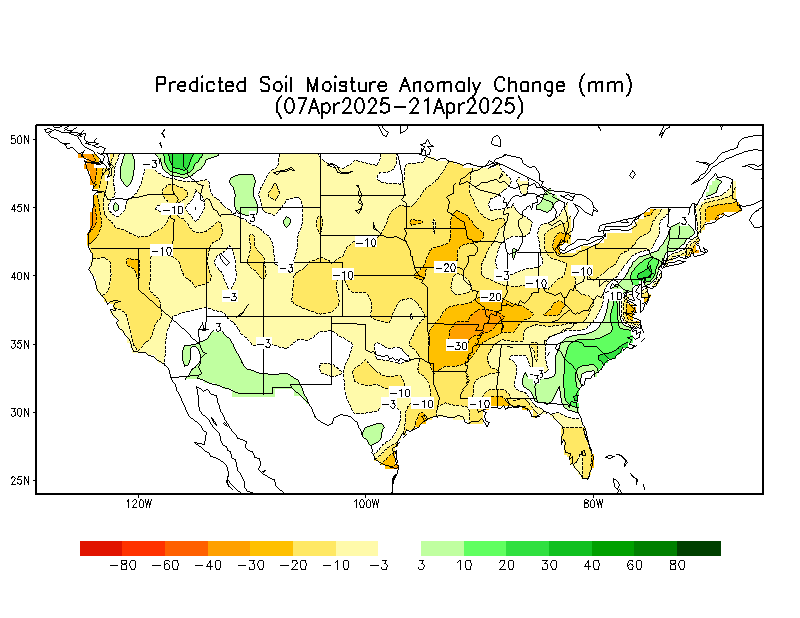
It looks like a wet fortnight is in store for almost the entire Midwest, according to QT Weather. This will do little to help North Dakota farmers catch up with normal planting progress:

Kansas Wheat Improving, Oklahoma Beyond Help
My chums at StormX offer an interesting insight into winter wheat crop developments today following last night's USDA ratings.
Kansas wheat has made steady improvement with heavy rainfall over the past couple of weeks, while wheat has been progressing through the rapid-growth phase, they say. The important heading stage will begin next week with an ample store of ground moisture. Wheat is gaining back lost yield potential, after a long winter drought. A statewide average yield of 46 bushels per acre is possible, if the weather continues to be favourable.
The crucial factor for Kansas wheat is that it was immature when a hard freeze developed in early April and did not suffer lasting damage, though development was set back for a time, say StormX. Wheat ratings have improved sharply in the past 2 weeks. As of April 25th, 48% of Kansas wheat was good-excellent, 37% was fair and 15% was poor-very poor. This was the highest condition report since last fall.
Unfortunately, it's a completely different story in Oklahoma, where wheat keeps worsening in the aftermath of a hard freeze that developed April 7th. Crop ratings declined to 9% good, 27% fair and 64% poor-very poor on April 25th, down sharply from 3 weeks ago.
Wheat in west-central and southwest Oklahoma was in the vulnerable booting stage when temperatures dropped to the low 20s F April 7th, leading to devastating losses where stems were damaged or killed. If water and nutrients cannot be transferred through the stems to the grain heads, kernels will never develop. Production is expected to shrink 35-50% in the affected crop districts, conclude StormX.
Strong Storms Hit Southern Plains Wheat
Heavy showers and severe thunderstorms are moving out of eastern Kansas Monday morning, say StormX. Since Saturday, nearly 4” of rain has fallen near Topeka. In Wichita, remarkably heavy rain fell on Sunday, with a daily total of 5.10”, three of which fell in just 6 hours. The storm total there is over six inches. Across the state, several reports of tornadoes and large hail have been found. In the past month, an impressive turnaround in weather across Kansas has occurred as drought concerns have now evolved into flooding issues. In southwest Oklahoma where drought conditions still exist, some locales have picked up around a half inch of rain. Across the state, showers and thunderstorms should continue throughout the day, especially in eastern sections. By Wednesday, rain should return to the Southern Plains, lasting through late Friday or early Saturday. With the new USDA crop condition reports due out early this week, we will soon know if the rain helped to improve the wheat conditions across Oklahoma where 60% was reported to be poor to very poor last week.
For more on this story click here
North Dakota Wheat Production May Fall 25 Pct
North Dakota wheat production may be reduced 25% due to serious planting delays that will shrink the wheat acreage sown, while also reducing the crop yield, say StormX. The current season is panning out very similar to excessively wet conditions that slashed wheat production in the state in 1999 and 1995.
North Dakota is the second largest wheat producing state in the US, and the largest spring wheat state accounting for 50% of production. A sharp cut in the 2009 wheat harvest would clearly be very detrimental for United States bread wheat supplies, particularly when Texas drought and Oklahoma freeze damage are added into the equation, say StormX.
Fields are saturated because of excessively heavy rain last fall and a thick snowpack that created flooding. Field conditions are similar to 1999, 1995, 1983 and 1972. In all four cases, production was sharply reduced compared with normal output, they add.
Wheat planting was delayed by 2-3 weeks in 1999 and 1995 because of flooding. Drying occurred very slowly, stretching out the planting campaign into late May. In fact, not all wheat was sown by June 10th. Farmers eventually ran out of time to plant, which led to a 8-10% cut in the area sown.
In summary, the cards are stacked against a favorable North Dakota wheat harvest in 2009, due to pre-existing wetness that inevitably will hinder planting and reduce the crop yield. A 25% cut in production is typical, when spring flooding is severe and similar to the present conditions, they conclude.


US Winter Wheat Latest
The US winter wheat crop is in a strange situation where promising crops seem to be getting better whilst poorer crops getting worse.
The USDA last night reported 43% of the crop rated good/excellent, that's a one point increase from last week. The percentage of the crop rated poor/very poor however also increased, up two points to 27%.
Wheat in the top US producing state of Kansas appears to be improving in potential, whilst in Oklahoma and Texas things are going from bad to worse.
The key factor in all of this seems to be the stage of development that the wheat crop was at when it was hit by a big freeze a fortnight ago. Crops in the more southerly states of Oklahoma and Texas were more mature and therefore more critically affected by temperatures well below zero for several hours.
"Irreversible damage occurs in the boot stage, when the grain head emerges from the leaf sheath to be pollinated, but Kansas wheat was just starting to joint," says Gail Martell of StormX.
"Oklahoma wheat is expected to have severe yield reductions in the western and southwestern crop districts, because the freeze caught wheat in the reproductive stage. The Oklahoma wheat rating deteriorated for the second week in a row, reflecting devastating losses, and is now 30% very poor, 30% poor, 28% fair and 12% good," she adds.
In Texas things are even more bleak for wheat, with 74% of the crop now rated poor/very poor, up seven points from last week.
Meanwhile spring wheat planting remains well behind schedule with just 6% of the crop in the ground compared to 21% normally, said the USDA. The recent heavy flooding in North Dakota means that that state has yet to plant any wheat at all. Recent analysts estimates point to up to 1 million acres of land intended for spring wheat in ND may not get planted.
Corn planting meanwhile is 5% complete, well behind the five year average of 14%, but things are expected to catch up rapidly for corn over the next couple of weeks with warmer temperatures on the way for much of the corn belt.
Flooding Causes Growers To Abandon US Spring Wheat Acres
US farmers have said they will abandon 200,000 acres of spring wheat in North Dakota and 100,000 acres each in South Dakota and Minnesota this summer due to record-breaking winter and spring snowfall and flooding, says Allen Motew of QT Weather.
Experts believe a further decline in acreage will result as heavy snow and further flooding occurred after the survey while soil temperatures reports show saturated or frost levels to 30 inches or more. Yields are projected to drop to the 5-year average of 38 bushels per acre from 40.5 last year, says Allen.
According to hydrologists at the River Forecast Center, “extreme meteorological conditions have dominated over the past 7 months”, and the fact that spring is just beginning, the Red River and its tributaries will be very susceptible to additional flooding for the remainder of Spring and into the Summer. Soil moisture rankings remain in the 99-percentile range across North Dakota, NW Minnesota and northern South Dakota. Around 72% of the nation’s spring wheat is grown across the Dakotas and W Minnesota, he adds.
Iraq Buys US Wheat
Iraq announced the purchase of 250,000MT of hard wheat Tuesday, with 100,000MT of it coming from the US. They also bought 100,000MT of Russian wheat and 50,000MT of Canadian wheat.
It is interesting that the US should pick up this surprise business, especially when you consider that the Russian wheat was just over $30/tonne cheaper than the US grain.
Some analysts are saying that the buy was a token gesture to President Obama who was making an unscheduled visit to Baghdad.
That wouldn't explain however the Canadian purchase, which was also priced substantially dearer than the Russian wheat. More likely, I'd suggest, is that much of the high quality Russian grain has already been sold & shipped this season, and that the North American purchases are based on quality.
Since the ousting of Saddam Hussein Iraq had been a major importer of US wheat, but the country's last major US purchase was way back in February 2008.
The country is expected to consume around 4 million tonnes of wheat this year, but produces only around one eighth of that.
US Wheat Crop Posts Sharp Decline In Condition
Monday night saw the first of the USDA's weekly crop condition reports for wheat since November. With winter wheat lying dormant in the ground no national reports are produced between November and March.
The last set of figures we had to go on in November said that 65% of the young crop was in good/excellent condition and that 8% of the crop was rated poor/very poor.
Last night's numbers show the percentage of the crop rated in the top two categories has fallen sharply to 43%, a 22 point drop since November, the joint second largest fall since the USDA started producing weekly figures in 1986. The average good/excellent rating for this time of year is 54%.
Meanwhile, the poor/very poor category has increased from 8% to 22% during the same period.
In Kansas, the top producing winter wheat state, the percentage of the crop in the top two categories has fallen from 74% to 39%. Whilst in Oklahoma it is now 25% from 63% and in Texas 12% from 48%.
In Texas a whopping 64% of the crop is now rated poor/very poor.
These figures are based on crop conditions as of Sunday. It will be very interesting to see how next weeks numbers pan out given the widespread sub-zero temperatures forecast for last night.
US Wheat Conditions Decline - USDA
The USDA reported worsening conditions in the major wheat growing states of Texas, Oklahoma and Kansas in it's weekly report last night. These three states grow almost half of the US winter wheat crop, with Kansas alone accounting for nearly a quarter of the nation's crop.
KANSAS saw the percentage of the crop rated good/excellent fall five points from a week ago to 45%. The poor/very poor category is now 17%, up two points from last week. Most of Kansas remained dry this previous week, said the USDA, with only counties in the Central and Northeast reporting precipitation. Topsoil moisture is rated as 27 percent very short, 35 percent short, 37 percent adequate, and 1 percent surplus.
OKLAHOMA received virtually no rain last week, continuing the decline of small grain crop conditions from dry weather, the USDA said. Good/excellent is down two points to 21%, whilst 43% of the crop is now rated poor/very poor.Oklahoma
TEXAS the northern part of the state received just trace amounts of rainfall while the rest of the state observed little to no moisture, the USDA said. Just 10% of wheat is rated good/excellent with 63% in the poor/very poor category.
US Winter Wheat Conditions Deteriorate
A USDA report issued after the close last night shows winter wheat conditions continuing to worsen in Texas. Oklahoma and Kansas.
The report says that as of the end of February Kansas had 50% of the crop rated good/excellent, down 9 points from the end of January. In Oklahoma only 22% of the crop is rated in the top two categories, whilst in worst affected Texas only 10% of the crop makes the top two grades.
In Texas 63% of the crop is now rated in poor/very poor condition, whilst in Oklahoma it is 42% and 15% in Kansas.
Meanwhile another week of hot and dry weather will affect the southern Plains this week, according to Allen Motew of QT Weather. The newly issued Climate Predication Center (CPC) monthly forecast keeps the southern Plains and Gulf Coast warm and dry for March, he says.